

What Is an ISO 17025-Compliant Laboratory, and How Do You Verify One?

Table of Contents

When a test result supports a regulatory filing, product release, safety decision, or compliance audit, you need more than a lab that’s fast and affordable. You need proof that the lab can perform your specific test correctly, and that its results will hold up.
ISO/IEC 17025 is the international standard used to demonstrate the competence, impartiality, and consistent operation of testing and calibration laboratories. But simply seeing “ISO 17025” on a laboratory’s website is not enough. The critical question is whether the laboratory’s accreditation covers the exact testing services you require.
Key Takeaways
- ISO/IEC 17025 evaluates laboratory competence, not general business quality or reputation.
- A laboratory is accredited to ISO/IEC 17025. It’s not “ISO 17025 certified” in the same sense that an individual earns a certification.
- Accreditation only applies to the tests, methods, parameters, and activities listed in the laboratory’s scope of accreditation.
- Regulated industries should verify both the laboratory’s accreditation status and its industry-specific testing capabilities before selecting a vendor.
- A current scope document, appropriate methodology, defensible sample handling, and independent accreditation verification are essential parts of vendor due diligence.
What Does ISO 17025 Accreditation Actually Mean?
ISO/IEC 17025, General Requirements for the Competence of Testing and Calibration Laboratories, establishes requirements laboratories must meet to demonstrate that they can produce technically valid and reliable results. Accreditation is performed by an independent accreditation body rather than awarded by ISO itself.
In practical terms, ISO/IEC 17025 asks whether a laboratory has the people, equipment, procedures, controls, and technical competence needed to perform its accredited activities consistently.
That being said, it’s important to understand what the standard doesn’t mean.
ISO/IEC 17025 is not a general business certification, a guarantee that every test performed by a laboratory is accredited, or proof that the laboratory meets every regulation in a particular industry.
The Difference Between “Certified” and “Accredited”
One of the most common mistakes in laboratory procurement is referring to an “ISO 17025 certified laboratory.”
The more accurate term is ISO/IEC 17025 accredited laboratory.
Certification and accreditation serve different purposes:
- Certification generally demonstrates conformity to a defined standard or management system.
- Accreditation provides formal recognition by an accreditation body that a laboratory has demonstrated competence for specified activities.
That distinction matters because accreditation is tied to a defined scope. A laboratory may hold ISO/IEC 17025 accreditation while only being accredited for particular tests, methods, analytes, matrices, or measurement ranges. So when you’re choosing a lab, don’t stop at the “ISO 17025 certified” statement. Instead, ask for the accreditation certificate, and, more importantly, the current scope of accreditation, which we’ll get into more detail about in a later section in this article, after we dive deeper into how ISO 17025 accreditation bodies work.
What ISO/IEC 17025 Requires of a Testing Laboratory
An ISO 17025 accreditation claim is only the starting point. The standard itself covers a lot of technical ground, but it really comes down to six things a lab needs to get right:
| Requirement | What It Means |
| Technical competence | The lab can actually perform its accredited tests correctly, not just on paper. |
| Qualified personnel | Staff have the training, experience, and hands-on skill the work requires. |
| Suitable equipment | Instruments are the right fit for the job, and they’re calibrated and maintained on schedule. |
| Impartiality | Testing is done objectively, with any conflicts of interest identified and managed. |
| Quality management | Documented processes keep operations consistent and catch problems before they become bigger ones. |
| Valid methods and results | The lab uses appropriate methods and checks that its results actually hold up. |
These requirements are intended to increase confidence in ISO 17025 accredited laboratory results.
How ISO 17025 Accreditation Bodies Work
No lab gets to award itself ISO/IEC 17025 accreditation. An independent accreditation body has to evaluate the lab against the standard’s requirements and decide whether it’s earned.
That process usually includes a documentation review, an on-the-ground look at how the lab actually operates, an assessment of technical competence, and a chance to fix any gaps before a final decision is made.
ANAB, A2LA, and Other Recognized Accreditation Bodies
In the United States, buyers may encounter accreditation bodies such as the ANSI National Accreditation Board (ANAB) and A2LA.
ANAB provides ISO/IEC 17025 accreditation for testing and calibration laboratories and maintains programs covering numerous technical fields and industries. Its laboratory accreditation programs are recognized nationally and internationally.
A2LA also provides ISO/IEC 17025 accreditation for testing and calibration laboratories. Its programs include specialized areas and industry-specific accreditation schemes.
The important point for buyers is that the name of the accreditation body is only part of the verification process. You still need to examine the ISO 17025 accredited laboratory’s scope of accreditation to determine what the accreditation actually covers.
What ILAC Recognition Adds
The International Laboratory Accreditation Cooperation (ILAC) supports international recognition of accredited conformity assessment results through its mutual recognition framework.
For organizations working across borders, this can make accreditation especially valuable. Rather than assuming that an overseas customer or regulator will recognize an unfamiliar accreditation body, businesses can look at whether the relevant accreditation body participates in the appropriate international recognition arrangements.
However, international recognition does not eliminate the need to review scope. An ISO 17025 accredited laboratory’s results are only covered by its accreditation when the testing activity falls within its accredited scope.
Understanding an ISO 17025 Lab’s Scope of Accreditation

The scope may be the most important document to review when selecting a laboratory.
Here’s why. A lab can be fully ISO/IEC 17025 accredited and still not be accredited for the exact test you need. The scope spells out precisely what the lab has proven it can do, down to specific methods, standards, analytes, matrices, measurement ranges, and sampling activities depending on the field.
Say a lab is accredited for certain chemical analyses but not for the specific gas analysis you need. Or it’s accredited for compressed air testing, but not for every method under ISO 8573.
That’s why “we’re ISO 17025 accredited” shouldn’t be enough to close the deal. The real question to ask is simpler and more specific:
“Are you accredited for this exact test, using the method we require?”
How to Read and Request a Lab’s Scope Document
Before sending samples or signing a contract:
- Ask for the laboratory’s current accreditation certificate.
- Request its complete scope of accreditation.
- Find the exact test, analyte, parameter, matrix, or measurement activity you need.
- Confirm the applicable test method or standard is specifically identified.
- Check whether the scope is current and applies to the facility that will perform your testing.
- Ask the ISO 17025 accredited test lab to explain any technical terminology you cannot interpret.
- Keep a copy of the scope as part of your vendor qualification records.
ANAB publishes specific requirements and guidance for developing scopes of accreditation, reinforcing that scope is a defined part of the accreditation process rather than a marketing description.
Questions to Ask When Reviewing a Lab’s Scope of Accreditation
| Question | Why It Matters |
| Is the laboratory currently accredited? | Accreditation status can change. |
| Who is the accreditation body? | Establishes who independently assessed the lab. |
| Is the exact test listed? | General accreditation does not cover every service. |
| Is the required method listed? | The method may be critical to regulatory acceptance. |
| Are the required analytes or parameters listed? | Accreditation may cover only part of a broader test category. |
| Does the scope apply to the testing location? | Accreditation may be facility-specific. |
| Is the scope current? | An outdated document may not reflect the laboratory’s present status. |
What to Look for in an ISO 17025 Testing Laboratory by Industry
The right ISO 17025-compliant laboratories depend heavily on what is being tested, where the results will be used, and which regulatory or industry requirements apply.
Food and Beverage
Food and beverage manufacturers may work under GFSI-recognized programs such as SQF, BRCGS, or FSSC 22000. ISO 17025 accredited laboratory testing can support:
- HACCP systems
- Prerequisite programs
- Quality controls
- Verification activities
For compressed air used in food production or in direct product-contact applications, buyers should confirm that the laboratory’s scope covers the relevant compressed air testing methods and contaminants.
The key question is not simply whether the lab is ISO 17025 accredited. Confirm that the specific food-related or compressed-air methods you require appear on its scope.
Pharmaceutical
Pharmaceutical manufacturers operate under demanding quality and regulatory requirements, including cGMP requirements in 21 CFR Parts 210 and 211.
When outsourcing testing, pharmaceutical companies should look for a laboratory with demonstrated experience in pharmaceutical testing and a scope that explicitly covers the relevant USP or other required compendial methods.
If a vendor says it can perform a USP test, ask whether that method is actually included within its accredited scope. A general ISO/IEC 17025 accreditation does not automatically cover every USP method.
Cannabis
Cannabis testing requirements can vary significantly by jurisdiction. State regulators may establish specific requirements for:
- Cannabinoids
- Contaminants
- Pesticides
- Heavy metals
- Residual solvents
- Microbiological contaminants
- Other analytes
Cannabis operators should therefore begin with their state’s requirements and create a testing checklist from them. Then compare that checklist against the laboratory’s scope.
Accreditation is valuable, but it doesn’t automatically mean the laboratory is accredited for every analyte required by a particular state.
Manufacturing
Manufacturers frequently use compressed air in processes where contamination can affect products, equipment, or production environments.
ISO 8573-1:2010 defines purity classes for compressed air based on contaminants including particles, water, and oil, and also addresses gaseous and microbiological contaminants.
A manufacturer evaluating an ISO 17025 accredited lab should confirm that its scope covers the relevant ISO 8573 test methods and parameters. The lab should also understand sampling at the actual point of use, particularly where compressed air comes into contact with products or critical manufacturing processes.
Medical
Healthcare facilities have specialized requirements for medical gases and breathing air. A hospital or healthcare organization should therefore look for an ISO 17025 accredited test lab with demonstrated competence in medical gas or medical air testing rather than relying solely on broad environmental or industrial testing capabilities.
Before selecting a vendor, confirm that the laboratory’s scope specifically covers the required medical gas or breathing-air tests and that its sampling and reporting practices align with the applicable healthcare requirements.
Fire Service
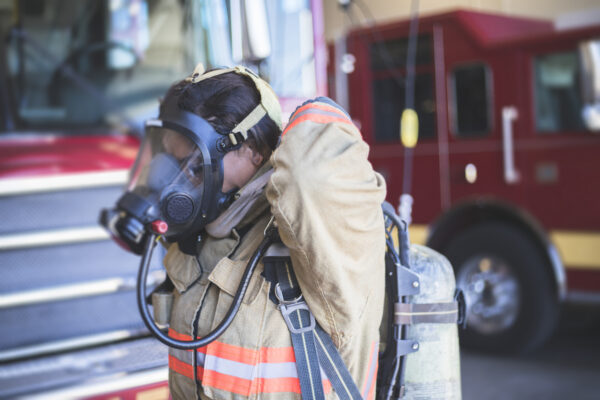
Fire departments need confidence that breathing air used in self-contained breathing apparatus is safe and meets the applicable quality requirements.
NFPA 1989 addresses breathing air quality for emergency services respiratory protection and includes requirements related to breathing air quality testing.
When evaluating an ISO/IEC 17025 accredited laboratory, fire departments should confirm:
- The laboratory is currently accredited.
- Its scope covers the relevant breathing-air tests.
- The sampling procedure is appropriate for high-pressure breathing air.
- The laboratory understands the applicable NFPA requirements.
- Reports clearly identify the tested parameters and results.
For additional background on firefighter breathing apparatus testing, see TRI Air Testing’s firefighter breathing apparatus resource and SCBA breathing air testing resources.
Diving
Scuba and commercial diving operations may require breathing air that meets applicable CGA Grade E requirements.
For diving applications, the sampling method matters as much as the laboratory’s accreditation status. Buyers should confirm that the laboratory understands high-pressure breathing-air sampling and that the method used is appropriate for the compressor, storage system, or breathing-air source being evaluated.
The ISO 17025 accredited lab should also be able to explain how samples are collected, handled, transported, and analyzed without compromising the integrity of the result.
Military
Military organizations may have highly specific requirements for air and gas purity, materials, equipment, and testing methods.
An ISO/IEC 17025 accreditation provides an important baseline, but defense-related buyers may also want evidence of experience with military specifications, government contracts, defense suppliers, or other specialized testing programs.
For these applications, technical history can be an important differentiator. Ask whether the ISO 17025 accredited laboratory has previously performed the relevant military-specification testing and whether those methods appear on its current scope.
Industry-by-Industry Accreditation Checklist
| Industry | Relevant Standard or Requirement | What to Confirm on the Lab’s Scope |
| Food & Beverage | GFSI-aligned programs, HACCP, applicable compressed-air requirements | Relevant food, microbiological, chemical, or compressed-air methods |
| Pharmaceutical | USP, cGMP, 21 CFR Parts 210/211 | Exact USP or other required compendial methods |
| Cannabis | State-specific testing requirements | Required analytes and methods for the applicable jurisdiction |
| Manufacturing | ISO 8573-1 and related methods | Specific compressed-air contaminants and test methods |
| Medical | Applicable medical gas and healthcare requirements | Medical air or medical gas testing capabilities |
| Fire Service | NFPA 1989 and applicable respiratory protection requirements | Breathing-air parameters and appropriate sampling methods |
| Diving | CGA Grade E and applicable diving requirements | Breathing-air parameters and high-pressure sampling |
| Military | Applicable military specifications and contracts | Exact military methods, specifications, and technical capabilities |
Red Flags That Signal a Lab Isn’t Truly Compliant

ISO 17025-compliant laboratories’ marketing materials can make accreditation sound straightforward. Vendor due diligence should go further.
1. Vague or Missing Scope Documentation
A prospective laboratory should be able to provide its current accreditation information and explain what its scope covers.
Be cautious if a vendor only displays an ISO logo, provides an expired certificate, or refuses to provide its scope of accreditation.
2. Accreditation That Doesn’t Match the Test Requested
This is one of the biggest red flags.
A lab may genuinely be accredited but not accredited for your specific test. If the requested method or parameter is outside the scope, ask whether the result will be reported as an accredited test or a non-accredited service. Take this distinction seriously.
3. No Clear Chain of Custody or Sample Handling Process
Accreditation does not eliminate the need for sound sample handling.
Ask how samples are identified, collected, sealed, transported, received, stored, and tracked. For field-based air and gas testing, also ask who performs sampling and whether the sampling procedure is included within the laboratory’s accredited activities where applicable.
A defensible result depends on more than what happens inside the ISO 17025 accredited test lab.
How to Confirm a Lab’s ISO 17025 Status Before You Sign On
A short verification process can prevent significant compliance problems later.
Questions to Ask Any Prospective Lab
These questions help distinguish genuinely ISO 17025-compliant laboratories from providers making broad or outdated accreditation claims:
- Who is your ISO/IEC 17025 accreditation body?
- What is your current accreditation number or certificate number?
- Can you provide your current scope of accreditation?
- Is the exact test and method I need included in that scope?
- When was your accreditation most recently assessed?
- Which facility will perform my testing?
- Is the requested testing reported as accredited or non-accredited?
- What sampling method do you use?
- How do you maintain chain of custody and sample integrity?
- Can you provide an example of the final report?
ISO 17025-compliant laboratories should be able to answer these questions clearly rather than relying on a generic statement that it is “ISO certified.”
Where to Independently Verify Accreditation
Do not rely exclusively on an ISO 17025 accredited laboratory’s own website.
Use the accreditation body’s directory or verification resources to confirm that the laboratory is currently accredited. For example, ANAB maintains a directory of accredited organizations, while A2LA provides accreditation services and related verification resources.
Independent verification is especially important when a test result will support a regulatory submission, customer qualification, audit, legal claim, or other high-consequence decision.
Choose a Lab That Can Prove Its Compliance

ISO/IEC 17025 accreditation is an important starting point when evaluating a testing laboratory, but it should never be the only box you check.
The strongest vendor-selection process looks beyond the accreditation logo. Verify the accreditation body, review the current scope, confirm the exact test method and parameters, evaluate sampling and chain-of-custody practices, and make sure the laboratory understands the requirements of your industry.
For regulated organizations, the goal is not simply to find a laboratory that says it is ISO 17025 accredited. The goal is to find a laboratory that can prove its competence for the exact testing you need.
TRI Air Testing provides laboratory testing services for regulated industries where reliable, defensible air and gas testing results matter.
If you are evaluating a testing provider, contact TRI Air Testing to discuss your testing requirements and determine what documentation and methodology you should expect from a qualified laboratory.



Related Articles
Air Sampling Kits – Video
TRI Air Testing offers sampling kits for use on free loan or for purchase. All...

Why wait? TRI Offers 24-Hour Turnaround Time
Compressed air testing is a vital component of many industries, both for verifying equipment functionality...
TRI’s Quality Program
At TRI Air Testing, quality is built into everything that we do. Our documented quality system...
